

[Brainstorming & Sketches] ➔ [ComfyUI / LoRA Exploration] ➔ [Photoshop / 3D Cleanup] ➔ [AI Motion Engine] ➔ [4K Topaz Mastering]
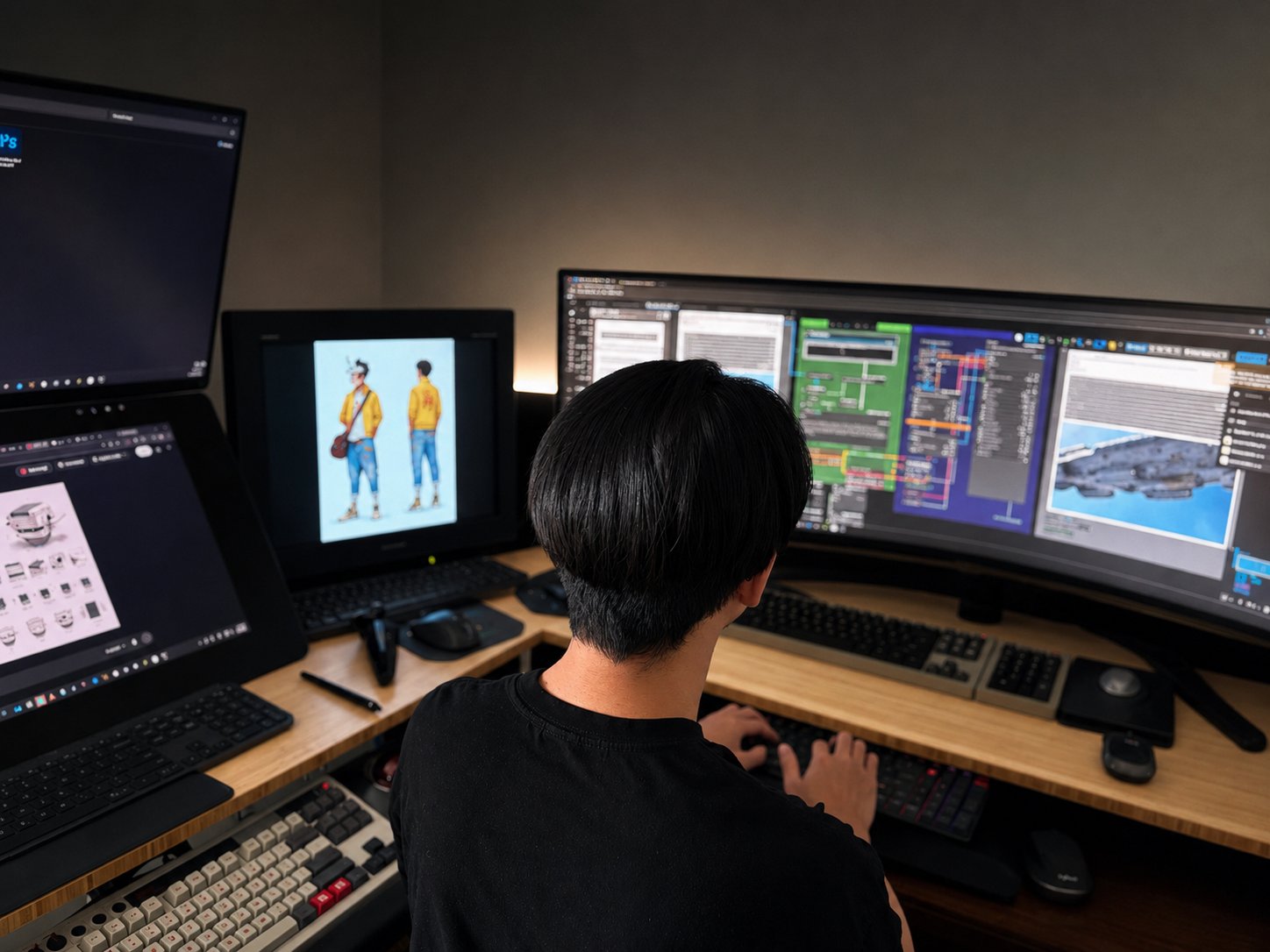
My workflow is concept-driven rather than tool-driven. Every project begins with my own creative development—including brainstorming, visual research, narrative exploration, and rough concept sketches—to establish the artistic direction before any AI generation takes place.
1. Ideation, Rapid Iteration & Model Control
Once the creative foundation is defined, I utilize a hybrid pipeline of cloud-based platforms and locally deployed AI networks to rapidly explore visual possibilities:
Core Toolkit: Midjourney, ChatGPT, and locally hosted ComfyUI workflows running advanced base models such as Stable Diffusion and FLUX.
Precision Control: I integrate, curate, and train specialized LoRA (Low-Rank Adaptation) models to maintain strict control over specific art styles, mechanical assets (droids/vehicles), and character consistency.
Purpose: These local node configurations are leveraged strictly for rapid ideation, form exploration, and generating diverse design directions rather than producing final artwork.
2. Traditional Refinement & Production Standards
After selecting the strongest concepts, I return to a traditional digital art workflow to ensure maximum fidelity:
Manual Oversight: Using Photoshop, I manually correct anatomical proportions, composition, perspective, lighting, and design language.
Artifact Elimination: I systematically eliminate common AI artifacts, remove excessive/noisy algorithmic details, simplify forms, and introduce intentional, hand-painted brushwork.
Result: The output is transformed into polished concept art that meets strict, studio-ready production standards.
3. Motion & Video Generation
For cinematic and moving content, I integrate both cloud and local image-to-video pipelines:
Next-Gen Video Engines: Incorporating advanced video systems including Wan 2.1, Kling, Seedance 2.0, and LTX.
Local Node Advantages: Utilizing local configurations allows for precise control over camera tracking, frame-to-frame consistency, and complex stylistic experimentation.
4. High-Resolution Delivery & Audio Pipeline
For final master delivery, I execute a high-fidelity post-production pipeline:
Upscaling: High-fidelity upscaling using Topaz Video AI or localized diffusion upscalers to achieve crisp 1440p or 4K outputs while preserving texture integrity.
Audio Architecture: Incorporating Suno for music architecture, ElevenLabs for voice generation, and Moises AI for advanced stem separation.
Conclude: All assets are seamlessly integrated during final video editing and multi-track mixing in post-production.
Throughout the entire pipeline, AI serves exclusively as an accelerator for production efficiency and lateral thinking. The core creative direction, definitive design decisions, and final quality control remain strictly under my manual and artistic supervision.